Nvidia’s Microduck Robots Surge Past 20,000 Preorders After GTC Berlin Demo
Consumer interest in the AI-powered duck robots spiked immediately following a viral demonstration by Nvidia’s CEO at a major industry conference.
By Rebecca Dawson ·
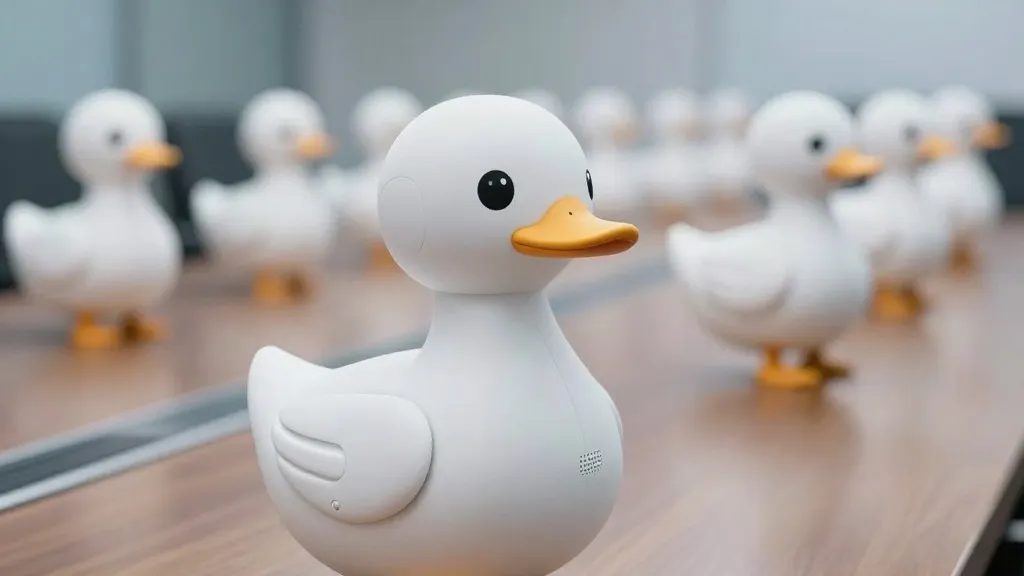
For consumers eyeing holiday gift options, a new category of tech gadget has emerged as a potential market leader. Within 24 hours of a high-profile demonstration, preorders for the Microduck robot surpassed 20,000 units. This rapid uptake suggests a strong shift in consumer behavior toward interactive, AI-driven hardware ahead of the Q4 retail rush.
The momentum began earlier this week during the GTC Berlin conference. Nvidia CEO Jensen Huang interacted with a group of the small robots on stage, where they performed programmed actions such as sitting, falling over, and executing somersaults. The devices emitted distinct robotic sounds and moved in a waddling motion, capturing widespread attention. By the following day, Hugging Face co-founder Clem Delangue confirmed the preorder milestone via social media, noting the volume of interest.
The timeline of the Microduck’s commercial rise is directly linked to corporate restructuring in the AI sector. The robots were originally developed by Pollen Robotics, a firm that was acquired by Hugging Face in 2025. Subsequently, Nvidia purchased Hugging Face in September of this year. This acquisition chain places the Microduck project squarely within Nvidia’s portfolio, leveraging its dominant position in the GPU and AI infrastructure market.
The product is built on an open-source architecture, a strategic choice designed to foster developer engagement. The robots utilize Nvidia’s technology stack for their initial training. Simulations were used to teach the devices fundamental behaviors, including walking, standing, and sitting, which are included in the standard shipping configuration. Pollen Robotics indicates that the platform allows owners to program new maneuvers, creating a potential ecosystem for user-generated content and community sharing.
Market analysts and company leaders are positioning the Microduck as a year-round device rather than a niche children’s toy. Delangue suggested that the unit could become the best-selling robot of the year, with promotional materials targeting adult users as well. The devices are scheduled for delivery in time for the Christmas season, positioning them to compete with established holiday staples in the consumer electronics sector.
This product launch offers a distinct contrast to recent market sentiment in the artificial intelligence space. The industry has recently faced scrutiny over AI’s role in various cyberattacks, which dampened investor and consumer confidence. The Microduck serves as a tangible, accessible entry point for the general public, potentially broadening the market for AI hardware beyond enterprise and developer segments. As the holiday selling season approaches, the success of this device will be a key indicator of consumer appetite for embodied AI.
The next phase for the Microduck involves scaling production to meet the current preorder backlog. With the technology being open source, the company is likely to focus on community expansion to drive long-term retention. The integration of Nvidia’s simulation tools into a consumer product marks a significant step in democratizing advanced AI capabilities, moving them from data centers into living rooms.
Source: TechCrunch